

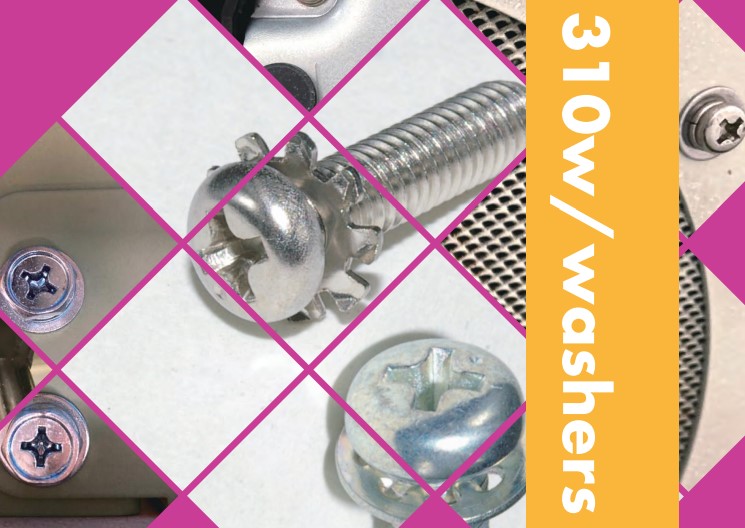
A washer is a thin plate with a concentric hole usually used to evenly distribute the load of a threaded fastener. Before a threaded fastener (such as a screw) is driven into a surface, it is usually placed on top of the washer, then both are driven together. The hole in the center of the washer can be round and uniform or non-uniform. These holes do not have to be straight.
A washer is typically installed on the inside of a nut, for example, between the bearing surface on which the shaft spins and a mating part that connects to it. The washer serves as an additional layer of material that prevents metal-on-metal contact (or grinding) and provides a better bearing surface than just bare metal contact.
A washer, sometimes called a spacer, is a metal ring with a hole in the center to protect surfaces from being scratched or indentated. The hole should be the same size as the bolt’s head and nut so that it can be placed on either side of the two fastened parts. When a screw is driven into wood, for example, the washer can be placed under one end of the screw head, preventing it from indenting the wood.

Introduction: What are Screws and Washers and Why Do We Need Them?
There are typically two main categories of washers: flat washer and spring washer. A flat washer is usually made of metal and provides a surface to distribute the pressure which is being applied to it. A spring washer is designed with a coil that creates an adjustment in the material thickness. This fitting reduces the chances of slipping or stripping out when tightened down with a nut.
Flat Washers
Flat washers are small metal discs with a hole in the center used to distribute pressure evenly in situations where a threaded object slides through a flat or curved surface. The role of flat washers is to increase the size of a screw’s bearing surface area, reducing the surface pressure applied on the fastened object.
Flat washers are often used in the construction of machines that have a high level of movement and need to withstand heavy torque on a regular basis. The inner ring is generally cone-shaped, which helps to improve the bearing surface. As screws are increasingly used in industry, it can be important to consider the bearing surface as this determines how smoothly they fasten an object. This is true if there’s low contact area, a soft material (like aluminum or resin)
Since there’s no fixed rule about which side of the washer should face up or down, you can put either the rounded or burred side depending on your preference. The most popular choice is to have the burred side facing down but that’s not something you need to worry about with our washers since they come in a variety of sizes and shapes.
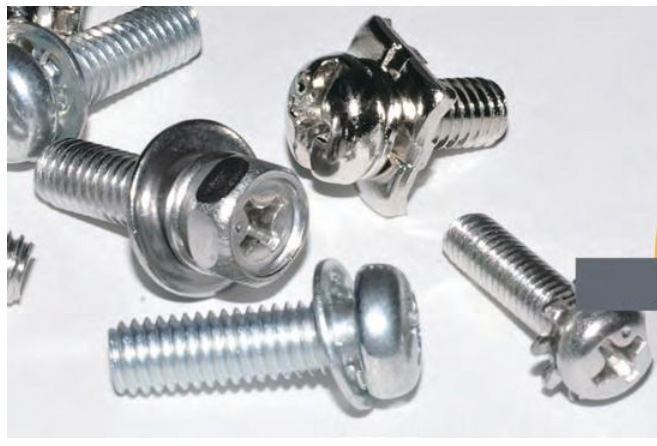
Spring Washers
Spring washers are typically made out of steel and are used to prevent two metal pieces from separating. The spring washer is placed over the bolt, and once the nut is tightened, it creates a tight seal over the bolt head, preventing any movement.
A spring washer is an external locking device. It is a small metal washer that is compressed between the nut and bolt threads by tightening the nut. As a result, a spring action or an elastic force operates. Unlike flat washers, which are placed on both the bolt and nut side, spring washers only go on the nut side of the fastener to establish a bond that will not loosen. In addition, it is not necessary to use a lubricant when using spring washers.
Spring washers are often used in conjunction with a flat or lock washer. The general usage is to provide increased frictional force by the cut part which “bites” into the bearing surface. The inside a spring washer is fitted with the kind of sharp edges that punch into the mounting surfaces, preventing counterclockwise rotation or loosening. This type of component would be an ideal addition to machinery subjected to high vibration.
Why are washers used with fasteners?
As weight dividers.
One of the fundamental purposes of washers is to distribute the threaded fastener with the shared material evenly. The pattern on a washer can be used to indicate the thread direction and pitch. A washer’s design can also determine how tightly it grips a bolt.
As space creators.
The product is to use when the threaded fastener is longer than the object’s depth. The washers are useful products that work in place of spacers. When the threaded fastener is longer than the object’s depth, it is not easy to drive the fastener into the material. Generally, a washer can be used between a nut and bolt head or nut and a surface
As vibration absorbers.
Certain type of washers are vibration damping or vibration-isolating washers. These types of washers can be found in a variety of industries and are used as a means to isolate or dampen the vibrations.
As liquid protectors.
There are several types of washers that protect the entry of liquid. They are frequently used in water pipes and connections to create a watertight seal.

Explore our vast catalogue of washer screws here. We have everything from screws, nuts and bolts available for purchase. There are many online stores that provide these types of screws, but they may not be the best option because they tend to be more expensive than buying them in person. A better option is to check with ANT Industrial that specializes in these type of products.
Visit our online store at https://ant-ind.com/ant-shop